
If you’ve ever estimated how many people might attend a school event, how much candy to buy for a party, or how many miles are traveled on a road trip, you’ve used an important math skill these students are mastering: rounding.
Students in Katherine Wallace’s fourth-grade math class at Arbor Station Elementary are learning to round multi-digit whole numbers — up to the millions — using place value and a simple rule: look at the digit to the right of the place you’re rounding to, then decide whether to “stay” or “go up.”
Students are practicing rounding numbers to the nearest ten, hundred, thousand, ten thousand, and beyond. By rounding, students can make large numbers easier to understand, estimate, and use in everyday situations.
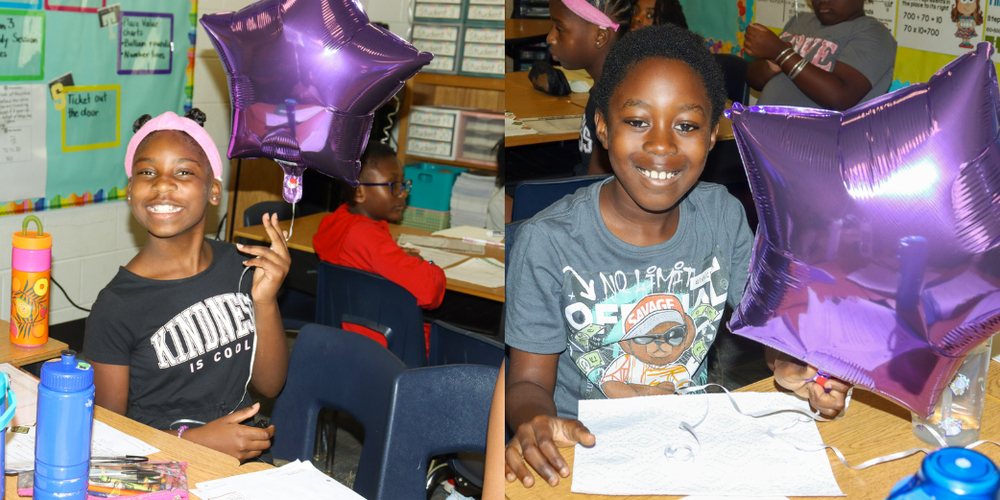
To make the lesson engaging and memorable, students are using balloons to demonstrate the power of place value.
Working in pairs, students use place-value charts extending to the millions. One student creates a multi-digit number, while the other determines how to round it. As they work through the problem, the student holds a balloon and counts on their fingers to represent the digit under consideration.
If the balloon is released, it represents the number “going up” to the next place value. If the balloon stays in the student’s hand, the number “stays” the same.
This hands-on activity gives students a fun visual way to see what happens when a number is rounded — and helps turn an abstract math rule into something they can see and remember.
With teamwork, movement and a little balloon-powered fun, these fourth graders are showing that learning about big numbers can be anything but boring.